Showing posts with label Dreamworks. Show all posts

Friday, 15 May 2015

How To Train Your Dragon


How To Train Your Dragon

DreamWorks Animation
Film released 2010
Director: Dean DeBlois and Chris Sanders
Writer: William Davies, Dean DeBlois, and Chris Sanders
Based on the book by Cressida Cowell
Starring: Jay Baruchel, Gerard Butler, Craig Ferguson, America Ferrera, Jonah Hill, Kristen Wiig, and David Tennant (Who knew?)
Rated: PG

Grade: 3.5/5


Mk. This one is another story of the queer “other.” There are lots of kids’ movies that take on this trope, some good, some bad, but this one is particularly intriguing when it comes to breaking down gender roles and femininity versus masculinity.

Let’s get into it.

WHAM! Right off the bat: alternative family structure (which gets even more interesting in the sequel, but that’s for another day). Our protagonist Hiccup (poor little Viking, seriously, they had to name him Hiccup?) has been raised by his giant Viking father his whole life with no mother in sight.

FEE FIE FOE FUM
Hiccup’s dad is the leader of the Vikings and a celebrated dragon hunter. He’s a giant dude. Hiccup on the other hand is a scrawny little boy. He can’t hold an axe, let alone kill any dragons. He’s basically the laughing stock of the whole Viking village because of this. Here’s where we get queer. Hiccup is not the Viking (read: man) he should be. His father tells him, “stop being all of you.” That’s harsh, bro. And “from the time he was born, he was different.” Sounds queer to me. Hiccup has to deal with toxic ideas of masculinity and gender role constructs.

Harold and Kumar and Hiccup?
Hiccup tries his darndest to measure up to the ideals of masculinity placed on him by his environment, but he just can’t. He’s labelled inadequate. But he does his best to compensate with his creativity! He invents things! He wants to prove himself within the confinement of the given environment (ie the norm): manly Viking men kill dragons.  But when he finally encounters the Night Fury he hit with his invention, he can’t do the deed. 

Excalibur!
He’s just not that kind of Viking. Hiccup starts to think outside the box, outside the construct. This is Hiccup’s queer aha! moment. He realizes that he cannot conform to the normative mode of manly Viking men who kill dragons. He accepts himself as a tiny Viking boy who trains dragons. He finds his success outside the norm, within his queerness.
Lil' Bub Toothless
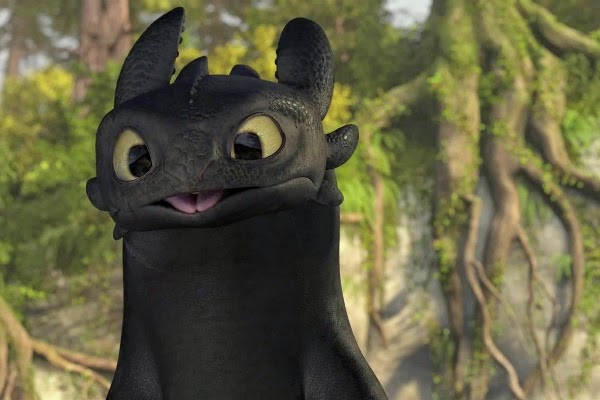
Hiccup is not the only one who is working outside the norm. We find this in the dragon Toothless, too. Toothless has learned through his/her (I don’t actually think Toothless gets gendered in the movie, not sure though. BUT HOW COOL IS THAT!?!) experience and encounters with humans, that it’s a kill or be killed world out there. Toothless also actively struggles with this construct, this norm. They become friends when they both accept the queer notion that they don’t have to kill each other. Their friendship proves that PEOPLE CAN CHANGE!

Don't send a boy to do a girl's job
Also, Astrid is a total feminist fierce independent lady. Hiccup’s crush on her is awesome for young boys to see a male character infatuated with a positive female role model. And she’s obviously good for young girls watching the movie.

What’s the take away on this one? Masculinity is more complicated than manly Viking men who kill dragons versus tiny Viking boys who train dragons. And it’s good to question social norms because you might just make a friend out of it J

MVQ: Toothless.
OTP: Astrid and the girl twin. Why not?
Favorite Moment: This:


Sorry this was a short one, I’m totally bogged down with work for my MA. Next post is gonna be up on Tuesday instead of Wednesday.

ALSO ALSO ALSO! I’m taking requests! Shoot me an email at thelamerest@gmail.com and I’ll add it to the list!


Friday, 17 April 2015

Home


Home
Dreamworks Animation
Released: 2015
Director: Tim Johnson
Starring: Jim Parsons, Rihanna, Steve Martin, Jennifer Lopez
Writer(s): Tom J Astle, Matt Ember
Based on the book The True Meaning of Smekday by Adam Rex
Rating: U for “Universal”

Grade: 4/5


WARNING! I will try my best not to spoil the movie for anyone who hasn’t seen it, but fair warning.

Guys, I was so close to ugly crying during this one. It’s definitely not an incredible movie (rotten tomatoes was not too keen on it), but it definitely has its moments. AND IT’S SO QUEER!

THE PROTAGONIST IS FEMALE AND A YOUNG PERSON OF COLOR! WHAAAAAT! Unprecedented. That’s honestly the reason why I wanted to see the movie. And I was super surprised to find out that basically the whole creative team are a bunch of white dudes. Which is kinda…weird? Whatever, good for them. Finally some white dudes are advocating for queer voices! My biggest complaint about the movie, honestly, is that the title is horrible. They couldn’t have figured out something a little more creative? Come on, guys.

Now to the story: we are first introduced to this alien race called Boov who are running away from their enemy, the Gorg, through the misfit Oh, so named for the reaction he gets from the other Boovs every time he enters a room. 

Oh is not your ordinary Boov. It’s actually really interesting how the movie introduces us to this culture through Oh’s perspective. Oh’s queerness is immediately present as we realize that he does not fit in, despite his blind optimism. Because we learn about this world from the queer perspective, the audience is left to connect the dots that make up the normative culture. The queer perspective gets prioritized over the norm perspective. That’s so cool! It also created a bit of a brain puzzle, trying to figure out why the other Boovs ostracized Oh so much when he seems so likeable to the audience. There are parts of Oh’s queer story that really hit home. (Spoilers! If you’re really a stickler…) Oh throws a party for his neighbours , but no one shows up. The other Boovs tiptoe past his apartment, careful not to let him know that they are just outside. Oh comes outside to find other Boovs, even wandering into another apartment, but he can’t find anyone to come to his party becase they are all hiding from him behind the couches. This scene (was it supposed to be comedic?) was actually kinda hard for me to watch. The cruelness of it really got to me. I’m glad the creators didn’t shy away from an honest portrayal of bullying.

Then we meet Gratuity “Tip” Tucci, our human protagonist played by Rihanna who KILLS it, btw. 

(Spoilers again!) So, when the Boov are running away from the Gorg, they arrive on Earth and “relocate” the entire human population to Australia. Pretty intense, right. Tip and her mom get separated during the relocation process and Tip gets left behind with her cat, Pig. The whole objective of the movie is to get Tip reunited with “my mom.” Not only do we have TWO WOMEN OF COLOR represented in the film, one of whom is the protagonist who has total plot driving power, we also see an alternative family structure with her mom as a single parent. There is never any mention of a dad, that he died, that he left, etc. It’s a non-issue. The focus here is on a loving mother-daughter bond, and a functional two-person family. BOOM. YES. MIND. BLOWN.

Then we get to the part where Tip and Oh meet. I won’t spoil all that for you, but all you need to know is they basically go on a road trip in a floating car. Sound good?  At first, they realllllllyyyyy don’t like each other. Being from antagonist species doesn’t really help the initial friendship. But they eventually learn to like each other. They take selfies and jam out. 

This friendship between queers is an awesome representation of collaboration across queer boundaries. Often, different kinds of queerness get sectioned off from each other culturally. Black culture is separate from gay culture, which is split into gay male culture and lesbian culture, latina/o culture is separate from trans culture, and so on an so forth. Intersectionalities make these separations even more complicated and narrow. Oh and Tip’s friendship builds the queer bridge between marginalized cultures. Even if a misfit alien and a young human girl of color have nothing in common from the outside, they share a queerness that bonds them beyond any cultural divides. I’ve found this to be true in most of the close friendships I’ve had in my life. I gravitate towards people who understand and identify as queer (explicitly or implicitly) in some way. Queers just get each other. Tip and Oh’s friendship also shows the power these collaborations can have. If queers would just bridge the divide and join forces, all those queer voices together could be much much louder than the normative folks. I think this is the real reason movies like this are starting to be made with queer protagonists. The entertainment industry is hearing the queer voices, particularly on the internet. Those voices are only getting louder. And that’s how progress happens, folks.

MVQ: Tip gets the win on this one. Did I mention that Rihanna kills.
OTP: Oh and Pig the Cat. Pig just fits so perfectly on top of Oh’s head.

Favorite moment: SPOILERS! I got super choked up when Tip and her mom finally reunited. Beautiful climactic moment.

Friday, 10 April 2015

The Prince of Egypt

The Prince of Egypt


Dreamworks Animation
Released: 1998
Director: Brenda Chapman, Steve Hickner, and Simon Wells
Starring: Val Kilmer, Ralph Fiennes, Michelle Pfeiffer, Sandra Bullock, Jeff Goldblum, Danny Glover, Patrick Stewart, Helen Mirren, Steve Martin, Martin Short
Composer: Hans Zimmer
Rating: PG

Grade: 4/5


THIS IS FOR ALL MAH JEWS OUT THERE! Happy Passover, Pesach, whatever floats your boat. I’m pretty bias because my Long Island Jewish family is huge and we had those stereotypical ginormous Jewish Seders that I always thought were really boring, but actually were really awesome, but Passover is definitely in the top 5 of awesome holidays. There’s excellent food, good company, comforting traditions and rituals, AND a great story to boot.

Before I start talking about the movie, I want to address this first. I’m not really a religious person. I identify as culturally Jew-ish. That said, I’m going to be look at this story as a story with no other religious weight attached to it outside of cultural symbolism and context. From my perspective, God is just another character. I apologize if I offend anyone by writing out their name. My intention is not to offend.

Now you might be thinking…this is a biblical story…how can that be queer? OMG IT’S SO QUEER! This is legitimately my favorite bible story and it’s because of how queer it is. It’s the ultimate story of perseverance through oppression and an interesting introduction to activism. The Egyptians versus the Jewish slaves. The norm versus the queer. Also, it has an insane all-star cast. Hello, Sandra Bullock.

Moses is different from his royal Egyptian family. His whole life he has ignored this fact. He’s been one of them, growing up with mountains of privilege, tearing through the city on his chariot with no regard for anything other than winning a race against his “brother.” 


But one day, all of that changes and the life he has known comes crumbling down around him. He finds Miriam in the street after chasing Tzipporah (who is an awesome feminist character with tons of chutzpah, btw) and Miriam flips that switch in his brain. “You were born of our mother Yocheved, you are our brother!” It's that OMG-I'm-totally-queer-and-have-been-since-I-was-a-tiny-little-swaddled-baby moment. He runs to the palace’s hieroglyphics and finds out the truth about how the Jews are treated by the Egyptian monarchy. He was found in a basket in the river because his mother wanted to spare him from the slaughter of male Jewish children.  Woah. 

That’s some heavy stuff to find out. That essentially his entire life has been a lie. “All I Ever Wanted,” speaks to that queer moment of recognizing that you are not of the norm, and how wrong it is that something can even be “norm” and prioritized over any other way of being. This is the liminal moment of transformation where he is still hanging on to everything he knows and loves before moving on to a hard but fruitful future as someone with a queer identity.


This realization boils over when Moses goes to the construction sight for Ramses new temple and sees the guard beating an elderly Jewish slave. Moses pushes the guard off the scaffolding and kills him. And Moses runs away into the desert. This is his public coming out, if you will, as a Jew. He aligns himself with the queer, oppressed population in his personal identity and politically.


Then comes the hippy dippy part of the movie when Moses joins the Jewish nomads, looks at his life through heaven’s eyes, gets married to the girl he objectified when he was a Pharoah’s son, becomes and shepherd, and takes too much acid and hears God speak to him through a burning bush…”Through Heaven’s Eyes,” should be the pro-gay religious anthem. It uses the religious idea of heaven to promote equality. WOAH! Something religious AND pro-gay/pro-equality? These things exist and they are awesome.

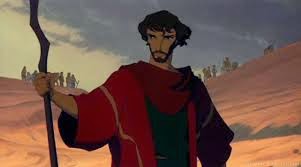
Then Moses goes back to Egypt with his magical staff. Um? Phallic symbol much? I think God is overcompensating or something. 

He wants his long lost Pharoah brother dude to LET MY QUEERS GO! But, surprise surprise patriarchy, he doesn’t do it. But Moses doesn’t give up asking. He continues to advocate for the oppressed queer population. If only all activist movements had a fancy magical staff that could enact God’s wrath in the name of equality. Alas…

Something I’m really glad this adaptation did was not to sugar coat the ending where  God sends down the tenth and final plague killing Egyptians’ first born sons. This shows the cost both sides must pay in these conflicts between queer and norm. Pharoah was stubborn for too long and he paid the price. Think of it as a warning to the patriarchy. You burn us, we burn you. It’s not the most non-violent approach, but it gets the point across.

Then there’s the famous parting of the red sea. I think everyone can agree the animation here is pretty damn cool. 

It’s also the final showdown. Ramses is just a plain dummy for trying to run after all those queers. He gets what was coming to him. For once the patriarchy is the bad guy and he gets his comeuppance. And then they sing “Miracles.” “There will be miracles / if you believe.” The final optimistic message of the movie. The queers can persevere and prosper. All you have to do is believe.

MVQ:  Jethro. That big old bear just wants everyone to love each other.
OTP: Miriam and Tzipporah. I ship it.

Favorite moment: There are a lot of awesome moments and it’s hard to pick just one. “Through Heaven’s Eyes,” is a close second, but I’m gonna have to go with “All I Ever Wanted.”