Showing posts with label Rated PG. Show all posts

Tuesday, 22 September 2015

Inside Out


Inside Out

Pixar Animation Studios
Film released 2015
Directors: Pete Docter, Ronaldo Del Carmen
Writers: Pete Docter, Ronaldo Del Carmen, Meg LeFauve, Josh Cooley, and a couple other peeps
Starring: Amy Poehler, Phyllis Smith, Richard Kind, Bill Hader, Lewis Black, Mindy Kaling, Kaitlyn Dias
Rated: PG

SPOILER WARNING! PROCEED AT YOUR OWN RISK! SERIOUSLY! ALL THE SPOILS!

Grade: 5/5


I’m back! Did ya miss me? Well, I missed you. Where else am I supposed to channel all of my suppressed inner queer child feels? Speaking of feels (perfect segue?)…let’s take a big queer look at Pixar’s newest installment in their hopelessly lost and miraculously found series: Inside Out!

If you live in a box in the middle of nowhere, then you probably don’t know what the movie is about. I’m here to help all the poor queer misanthropes out there.

Our story begins with Riley (Kaitlyn Dias), a happy little girl who lives in Minnesota, loves hockey, her family, her friends, and lives a pretty darn joyful tomboy life. 

I scream, you scream, we all scream for ice cream!
Cue the actual subject matter of the movie: Riley’s inner emotional life, literally. Pixar introduces us to Riley’s emotions: Joy (Amy Poehler), Sadness (Phyllis Smith), Fear (Bill Hader), Anger (Lewis Black), and Disgust (Mindy Kaling). Joy is the ruler of Riley-land and she’s loving life bossing around the other emotions and making sure Riley stays – you guessed it – joyful. 

Left to right: Anger, Disgust, Joy, Fear, Sadness
That is until Riley’s parents decide to uproot and move to San Francisco for Dad’s new job with a startup. The move throws Riley’s emotions totally out of whack and Sadness starts to challenge Joy’s chiefdom, which she does not take sitting down. When Sadness touches a core memory (I would explain this but it’s complicated and you should just watch the movie dumdum) and it turns from a joyful memory to a sad memory about missing her old life in Minnesota, chaos ensues leading to Joy and Sadness getting accidentally ejected from headquarters and they end up between the shelves of Riley’s long term memories. Riley is left without the ability to feel either Joy or Sadness and Anger, Disgust, and Fear can’t hold down the fort. Joy and Sadness meet Riley’s old imaginary friend, the awesome BingBong, and try their darnedest to get back to headquarters before Riley runs away from home! 
They can't tell I'm running away to a spoken word open mic, can they?
Okay, whew, that’s the basic plot. Let’s get into the queer stuff.

First! Major points for female representation! We have not one, not two, but THREE female protagonists (depending on how you categorize protagonist in this movie)! We’ve got Riley herself, Joy, AND Sadness all presenting as female. This movie is only Pixar’s second with a female protagonist (Brave was the first, duh) and they’re going whole hog this time a-round. Despite most of the story and writing team being almost entirely male (ugh, Pixar, get with the program already), the female characters are complex, well-imagined, and all around relatable depictions of women. You go Pixar!

Second. There’s been a lot of internet talk about how gender factors into the movie. We get a sneak peak at some of the emotional inner life of the other characters in the movie (primarily Mom and Dad, but there are a ton of others too) and the genders of everyone’s five primary emotions seem to align with the characters' genders, except for Riley’s. For Riley, Joy, Sadness, and Disgust are female while Anger and Fear are both male. People have taken to the internet to discuss what this means. Is Riley trans? Queer? Genderfluid? Genderqueer? Non-binary? WHAT DOES THIS MEAN?!? Well, I hate to burst your hopeful little queer bubble but here’s a quote on the topic from the one and only Mr. Director Pete Docter, courtesy of the IMDB trivia page:

When asked about the genders of the emotions, Pete Docter said, "It was intuitive. It felt to me like Anger's very masculine, I don't know why ... Sadness felt a little more feminine and Mindy Kaling as Disgust felt right ... with Mom and Dad, we skewed them all male and all female for a quick read, because you have to understand where we are, which is a little phony but hopefully people don't mind!"

Womp womp womp...But I still think there is hope! Docter is basically saying that he only made everyone else's emotions one gender because of exposition...But I think it’s actually way more nuanced than that, even if he doesn't know it. But I don't completely agree with the discussions happening online either.

Disclaimer: This opinion is mine and mine alone as a cis gender woman who does not have a mental illness. Please feel free to chime in with your opinion if you disagree with the following theory. 

That said, here’s my take:
I have found that my gender identity is not at all tied up in my emotional life. My emotions have a much stronger connection to my gender expression rather than my identity. I am and always will be a tomboy. I am happiest when I get to live comfortably within that expression. I am unhappy when I’m forced out of that comfort zone and, for example, am forced to wear a dress, skirt, or anything like that. Gender identity and gender expression are two totally different things. I am a woman but I tend to wear mens clothing. That doesn’t make me trans*, that makes me a tomboy, as per my personal preference for that label. I am a female and I am a tomboy. That identity and that expression are not contradictory or in conflict, they actually compliment each other quite nicely. I think that the genders of Riley’s emotions represent femininity vs masculinity instead of female versus male. Riley’s emotions are personifications of concepts and concepts inherently have no gender. They are actually genderless (so they are actually, technically non-binary). But they present as either feminine or masculine. Rather than her emotions representing Riley’s gender identity, I think they are a manifestation of her gender expression, aligning with her clearly identifiable tomboy proclivities. Riley is a girl with a slightly masculine expression, that’s why 2/5 of her emotions present as masculine. As for the other characters, their emotions’ gender ratios align with their gender expressions. Mom dresses femininely and her emotions are all female presenting; dad dresses masculinely and his emotions are all male presenting. This idea applies to all the characters whose emotions are shown, even the dog!

Okay, there’s a lot to unravel in there. I’m gonna leave it at that for now cause I could write a thesis on that topic alone.

Moving on. This is a big one: mental health. This movie is basically a giant PSA for kids that growing up is hard and it’s okay to feel your feelings, even when you are sad, or mad, or happy, or scared, or disgusted, and that KIDS’ FEELINGS ARE LEGITIMATE. So often kids’ emotions are disregarded because young people are just that, young. But young people are also people with rich inner emotional lives. And because kids are also people with these huge inner emotional lives, they also need to take care of their mental health, the same way adults should. Riley can’t function properly or process the huge change that is going on in her life because she can’t feel either Joy or Sadness. Both are equally important. And Joy’s journey throughout the movie, coming to accept that Sadness is a necessary part of Riley’s emotions is SO IMPORTANT. Everyone needs a good cry every once in a while, am I right? This movie is putting mental health front and center in an incredibly accessible way. I really hope this helps kids who are depressed and have serious mental health issues identify what is happening to them and get them to seek help, knowing that it’s okay to talk openly about their feelings.
You're future looks...sad
And last but certainly not least, THEY MADE A TASTEFUL EXPLICIT GAY JOKE! I can’t remember the exact quote but Fear says something about being scared of bears attacking Riley, and the other emotions are like, “there aren’t any bears in San Fransisco,” and Anger says that he saw a bear walking down the street earlier and I almost died of shock/happiness/laughter. This joke was 1) hilarious, 2) super casual and nbd, and 3) AN EXPLICIT GAY JOKE IN THE MIDDLE OF A HUGELY GROSSING PIXAR MOVIE THAT MILLIONS OF KIDS ARE SEEING AROUND THE WORLD! This. Is. Huge. And while the joke will most likely go over most kids' heads, parents will certainly catch it and that’s enough for me. One small step for gays, one giant leap for gay-kind.

MVQ: BingBong. He’s my hero. Also, his flying wagon is powered by rainbows, which is just the best thing Pixar has ever thought up.
BingBong BingBong
OTP: Joy and Sadness. The perfect yin-yang. They’d make a well-balanced couple, maybe?
Favorite Moment: I lol’ed so hard when Sadness, Joy, and BingBong were in the abstract thought chamber. That was some seriously funny intellectual humor and I’m a total sucker for nerdy stuff like that. I’m really glad they put that in a kid’s film.


Thursday, 16 July 2015

Harry Potter and the Chamber of Secrets


Harry Potter and the Chamber of Secrets


Bloomsbury (UK) & Scholastic (US)
Book released 2 July 1998 (UK) & 2 June 1999 (US)
Written by JK Rowling


Warner Bros.
Film released 2002
Director: Chris Columbus
Writer: Steve Kloves
Starring: Daniel Radcliffe, Rupert Grint, Emma Watson, Richard Harris, Kenneth Branagh, every British actor ever
Rated: PG


Grade: 5/5


Mk, let’s return to the wizarding world and the second instalment of JK Rowling’s gift to humanity. God is a woman and her name is JK Rowling.

We’ve covered the queerness of Harry literally coming out of the closet, the queerness of wizardry, the beginning of Hermione’s war against the patriarchy, and the gayest gay of them all, you guessed it, Dumbledore, and now we need to talk about a couple of things that come up in the second book that just make the series that much queerer.

First up, Dobby and the house elves

The biggest thing the movie leaves out is the genius of SPEW. For those of you plebeians who are not in the know, SPEW stands for the Society for the Promotion of Elfish Welfare and it begins Hermione’s single-handed pursuit to emancipate house elves. SPEW has a (mostly) consistent presence throughout the series and I’ve always been super disappointed that it got left on the cutting room floor because it is seriously genius and it establishes Hermione as a passionate activist. House elves are about as queer as you can get. They are essentially an enslaved population, taken advantage of by wizards. So much queer oppression going on. When Dobby meets Harry and he’s actually the first person ever to even say one nice thing to Dobby and care about his wellbeing and all he does is politely offer him a seat, you know there’s some hateful bigotry going on in the background of this poor character’s life. I don’t think this one needs much more explaining; the queerness here is pretty explicit. I mean, he wears a pillow case for goodness’s sake.

Next, we really get a better sense of the Weasley’s economic status in this book/movie. They’re a huge family squeezed into this tiny house that barely fits all of them. 

They have to buy second hand everything and they work hard for what they do have. But what’s important in the depiction of their economic status is that, while it is sometimes a source of shame for Ron, they are an incredibly happy family. Harry even envies them and the life they lead. Mr. Weasley loves the work that he does and is incredibly passionate and together, they persevere to make it work. Their poverty rarely reveals itself as a set back. On the contrary, their family becomes idyllic through Harry’s eyes. Queer points for the Weasleys!

Before I get to the big queer issue of the book, I wanna talk about Hagrid for a little bit. 
We get a bit more of his backstory in this book, although not all of it, but I want to talk about him anyway and maybe reference some stuff that we learn about in other books. In Chamber, we learn that he was expelled from Hogwarts as a teen because Tom Riddle (aka young Voldy) framed him for being the heir of Slytherin and killing Moaning Myrtle. And he gets shipped off to Azkaban in this book because they think he was the one who re-opened the chamber. We don’t learn explicitly until book four that Hagrid is half-giant, but the discrimination he faces in this book (and honestly in most of the others) establishes his queer status before we understand the full extent of his queer identity. I think it is important to acknowledge it here because of the parallels it makes to ableism. Hagrid is often treated like a lower being than the rest of the wizarding community. He’s looked down upon, called an “oaf,” and generally faces a lot of demeaning bigotry. His half-giant status not only establishes him as outside of pure blood wizards, but also within another species category that is generally thought of a intellectually inferior to wizards. There’s more to talk about once we get to The Goblet of Fire and The Order of The Phoenix, so I’ll save the rest till then. Just know that Hagrid is hella queer.

The big one in this instalment is the beginning of the pure blood versus muggle-born debacle. This is where we first hear the slur, “mudblood.” 
And the whole Chamber of Secrets thing is laced with near genocidal rhetoric. The heir of Slytherin is out and about again and on the hunt for muggle-born blood. This pure blood/muggle-born clash basically drives the plot of the entire series with Voldemort’s obsession with essentially, purifying the entire wizarding world (cue the allusions to Hitler and WWII). It’s the racial debate of the wizarding world, and its queerness is overwhelming. Malfoy’s bullying of Hermione brings the issue into full focus and we get to see the horror of the issue unravel through Harry’s eyes. Any queer kid getting bullied at school can relate to Hermione’s experience with Malfoy and her struggles with prejudice just because of who her parents are. AND SHE’S STILL THE BEST WITCH IN HER CLASS! If that’s not overcoming adversity then I don’t know what is.

A few quick queer things:

-Lockhart is totally queer. But he’s a pretty crumby guy so let’s not talk about that.
-I’ve always thought there was a bit of an undertone of mental heath going on with Harry being about to hear the snake through the walls and with Ginny and her dependence on Riddle’s journal. Not quite sure what to make of it though.
-lol, Ron’s fear of spiders. Not only is it totally relatable, but it also subverts gender stereotypes. Ron would be screaming like a little baby while Hermione swats at spiders in their kitchen.

MVQ: Dobby.
OTP: Still looking at me and Hermione…I mean really, who doesn’t ship themselves with Hermione?
Favorite Moment: Dobby gaining his freedom with Harry’s smelly sock.


Monday, 1 June 2015

Brave


Brave

Pixar Animation Studios
Film released 2012
Directors: Mark Andrews, Brenda Chapman, Steve Purcell
Writer: Brenda Chapman, Mark Andrews, Steve Purcell, Irene Mecchi
Starring: Kelly Macdonald, Billy Connolly, Emma Thompson, Robbie Coltrane, Kevin McKidd, Craig Ferguson
Rated: PG

Grade: 3/5


I was in Scotland all last week so it felt appropriate to take a look at Pixar’s BRAVE!
 
SO MANY SHEEP
Guys, this came out in 2012. How crazy is that?!? Pixar’s first and only (up until this summer’s release of Inside Out) female-led film. I love you Pixar, but you really need to get better with the whole representation thing…

Anyway, so this movie…I’m curious what other people have to say about this one. I wish it was my favourite Pixar movie, truly I do. But, it’s just not. That’s not to say that it’s a bad movie. By all standards, it’s a good movie. The animation is gorgeous (as always) 
Now how do I get back down....

and Merida is such a rebellious bad-ass. But it’s not great. And I don’t expect anything less than greatness (in terms of storytelling) from Pixar. It’s good, but it’s not as good as you want it to be. I’ve been trying to pin point why I feel this way, and I’ve maybe found an answer. Let’s start at the beginning.

I love the first part of this movie. It’s super feminist and interesting and queer and breaks all kinds of stereotypes. You’ve got this mother/daughter thing, dealing with the old versus the new. Merida is this adventurous, tomboy teen (although I wish she didn’t always have to wear dresses, that would have bothered me as a kid) who goes around shooting stuff with her bow and arrow, climbing mountains on her horse, drinking from the waterfall of fire, and generally kicking major ass. 

I'm ginger and I know it
Her mother, on the other hand, is steeped in the tradition of her people, although she definitely has her own moments of queerness. Here’s where they differ: Merida is all about freedom and adventure and expressing herself with her curly ginger locks blowing in the gales, while her mother channels those same impulses through the strictures of her tradition. She adheres to the normative code of what princesses and queens should and should not do and tries to confine Merida to those rules. Momma queen is able to take those rules in stride and totally dominate within that world. The mother/daughter feud that springs from their old versus new ways is the common struggle of the generations, particularly between generations of activists. Think Act Up Fight AIDS and their aggressive campaigns versus today’s Marriage Equality movement which wages its battle through politics and policy pushing. It’s not a perfect parallel, but I think you get the idea.
Merida, the patriarchy is everywhere, there is no escape

THEN we get to the whole heteronormative marriage tournament thing. I really love the visual metaphor here of her hair getting covered up by that weird hood thing she has to wear with her confining fancy dress, and she keeps pulling one tiny ringlet of ginger curl out from under it even though her mother keeps tucking it back. Brava, Pixar. 
BO-RINGLET

Strong metaphor for Merida’s personal expression and individuality. The tournament itself is your typical patriarchal BS, but then Merida wins her own hand through a sneaky loophole and some insane archery skills. WHICH IS SO AWESOME AND FEMINIST AND I WISH THIS MOVIE CAME OUT WHEN I WAS A KID!

And then the movie gets eh…

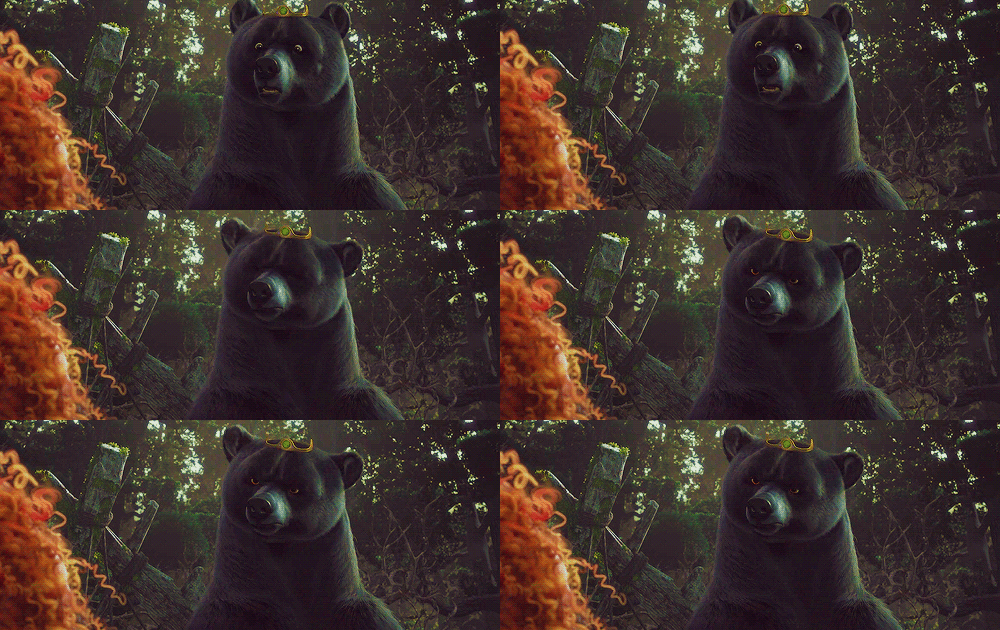
The bear doesn't like its own plot twist #meta
Merida gets mad at her mom and tries to find the Will of the Whisps (magic stuff) to get her to understand where she is coming from. And then she accidentally turns her mom into a bear…While she does visit a witch-ish character, that just doesn’t really make up for how much I dislike this plot “twist.”

From a storytelling perspective, I just don’t think they introduced the magical aspects of the world very well. And they completely drop the really interesting feminist/queer stuff in lieu of this bear-transforming thing that happens. The plot had so much potential! And they just drop it all because they want to do this weird mother/daughter oops I turned you into a bear and now we need to undo the thing that I did so you can be human again plot. Ugh, boring. Do any Pixar movies even explore father/son relationships? No, I don’t think so. (Well, they kind of do in Finding Nemo but that still manages to be an awesome adventure story and Nemo and Marlin are barely on screen together.)

If Pixar had chosen to do a different Viking film with a male protagonist, he would have been going on adventures and doing cool Viking stuff, not turning his mom into a bear and then trying to undo that mistake. That’s probably why How To Train Your Dragon is the better Viking movie.

Here’s my alternative version of the movie: Merida runs away from home after the tournament to fight dragons (or bears, whatever) and and see the world and do everything a boy can – skipping all the bear-transforming nonsense and actually meeting people on her travels and finding out what it is like to be an independent woman in this world and making some self-discoveries along the way - and then when she gets herself in too much of a pickle, her mom would show up to save the day and reveal herself as the bad ass she truly is and female empowerment and bridging the generations and YAY. It would end the same way, with the marriage thing chucked out the window and Merida would let her hair fly free as she rides with her newly liberated momma by her side. That would have been an epic movie.
And they all lived happily ever after

Got a better alternative version?

Also, did I mention that Merida is totally a lesbian?

MVQ: Her dad! He’s awesome. And his impression of Merida is spot on.
OTP: Merida and her badass self.
Favorite Moment: The split screen talk between Momma Queen and Poppa Viking and Merida and her horse. Brilliant.